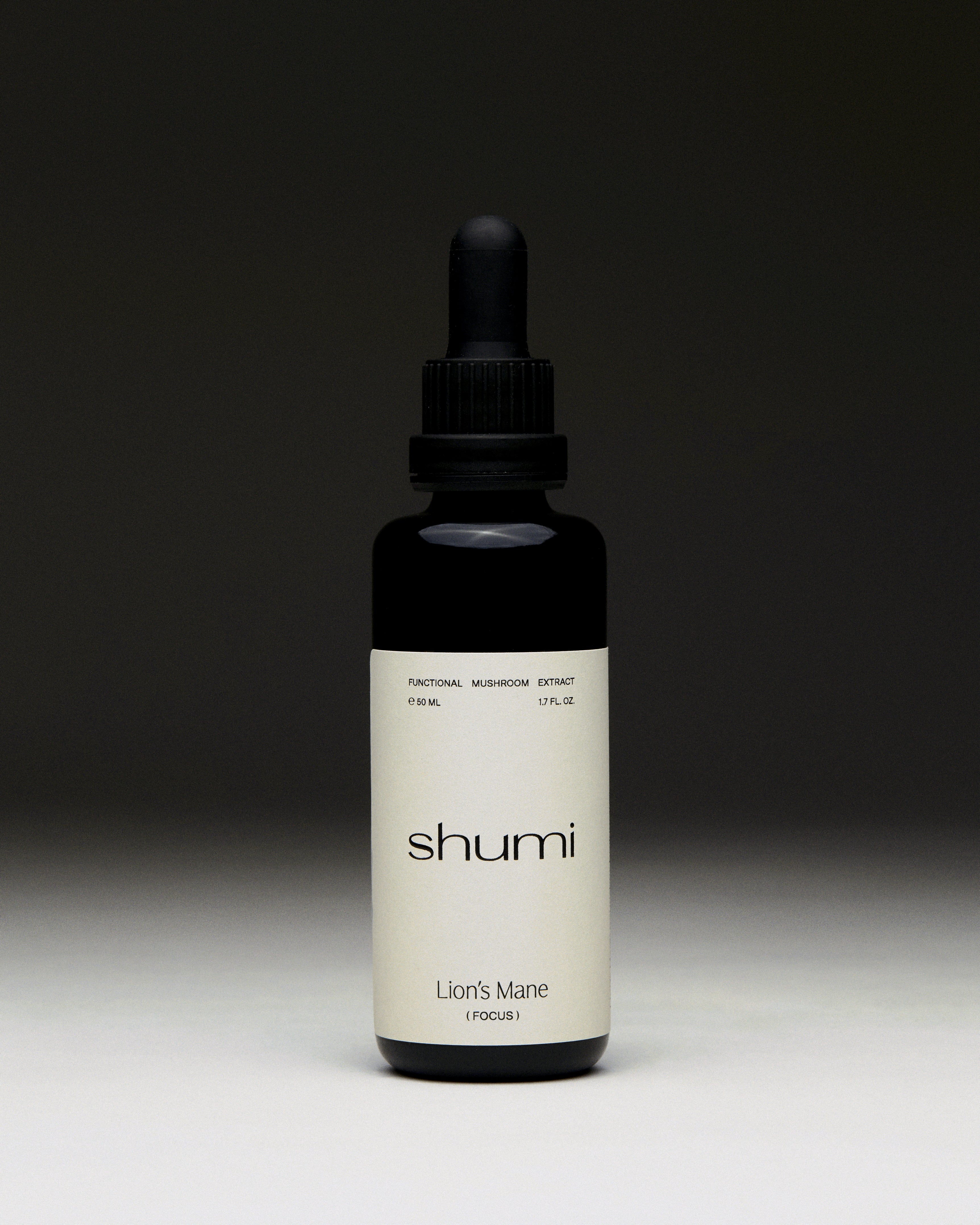


Short answer: liquid extracts are generally considered to absorb faster and to offer more active compounds per serving, so many people find they suit a daily wellness routine. Powders are cheaper and behave like a food, which makes them handy in the kitchen. But the real question is not "extract or powder", it is whether the product actually delivers absorbable beta-glucans, and that comes down to how it is made.
Why the format shapes what your body can absorb
Mushrooms hold their active compounds, beta-glucans, triterpenes and others, inside cell walls made of chitin, the same tough fibre found in shellfish shells. Human digestion does not break chitin down well, so raw or simply dried-and-ground mushroom is generally thought to leave much of the goodness trapped inside. This one point explains most of the extract-versus-powder debate.
An extract is designed to address it. Hot-water and alcohol extraction help break open the chitin walls and draw the active compounds into a concentrated liquid the body can more readily use. At Shumi we combine dual extraction with ultrasonic extraction to release those compounds while protecting the heat-sensitive ones. A plain powder, unless it is specifically an extract powder, is just dried mushroom: convenient, but with generally less available to absorb.
Mushroom extract vs powder, at a glance
| Feature | Liquid extract | Powder |
|---|---|---|
| Absorption | Generally faster; cell walls already broken down | Generally slower; chitin can limit uptake |
| Active compounds per serving | High and concentrated (e.g. 10:1) | Lower, unless it is an extract powder |
| Convenience | Drops into any drink, no prep | Needs mixing into food or smoothies |
| Best for | A daily supplement routine | Cooking and food-first rituals |
| Taste | Mild, blends in | Earthy, can change a dish |
| Typical serving | Small, about 2 ml | Larger scoops |
How to choose a mushroom product that actually works
Format matters less than quality. Whichever you choose, check for these four things:
- Fruiting body, not mycelium on grain. The mushroom itself carries the beta-glucans. Mycelium grown on grain is often mostly leftover starch.
- A stated extraction method and ratio. "10:1" means ten parts mushroom to one part extract. If no method is listed, there may be little real extraction.
- Beta-glucan content, not just "polysaccharides". Polysaccharide figures can include grain starch. Beta-glucans are the part you actually want.
- Third-party or batch lab testing for both potency and contaminants.
Shumi's extracts are made from organic fruiting bodies, dual and ultrasonic extracted, batch lab-tested, and EU & USDA certified organic. For the science behind it, see why bioavailability matters in mushroom supplements.
When a powder is the right call
Powders are not "worse" for every use. A good fruiting-body powder is a fine choice if you like cooking mushrooms into meals, prefer a food-like ritual over a supplement, or want a slow, gentle intake through the day. Just expect to use more of it to match the potency of a concentrated extract.
Choose a liquid extract if you want
- Fast, efficient use of a small daily serving.
- A no-prep routine: a couple of droppers into coffee, tea or water.
- Plenty of active compounds for your money, once absorption is taken into account.
How to use a liquid extract
A typical serving is 2 half-droppers (about 2 ml):
- Morning focus: a few drops of Lion's Mane in coffee or tea.
- Evening wind-down: Reishi an hour or two before bed.
- Fastest uptake: hold the extract under your tongue for 20 to 30 seconds before swallowing.

Ready to switch to extracts?
Explore Shumi's organic, ultrasonic-refined liquid extracts, or start with a set that matches your routine. Shop all functional mushroom extracts, or try the Holistic Wellness Set to explore all four in one place.
References
- Kumar, K., Srivastav, S., & Sharanagat, V. S. (2021). Ultrasound assisted extraction (UAE) of bioactive compounds from fruit and vegetable processing by-products: A review. Ultrasonics Sonochemistry, 70, 105325. https://doi.org/10.1016/j.ultsonch.2020.105325
- Szućko-Kociuba, I., Trzeciak-Ryczek, A., Kupnicka, P., & Chlubek, D. (2023). Neurotrophic and Neuroprotective Effects of Hericium erinaceus. International Journal of Molecular Sciences, 24(21), 15960. https://doi.org/10.3390/ijms242115960
- Mori, K., Inatomi, S., Ouchi, K., Azumi, Y., & Tuchida, T. (2009). Improving effects of the mushroom Yamabushitake (Hericium erinaceus) on mild cognitive impairment: a double-blind placebo-controlled clinical trial. Phytotherapy Research : PTR, 23(3), 367-72. https://doi.org/10.1002/ptr.2634